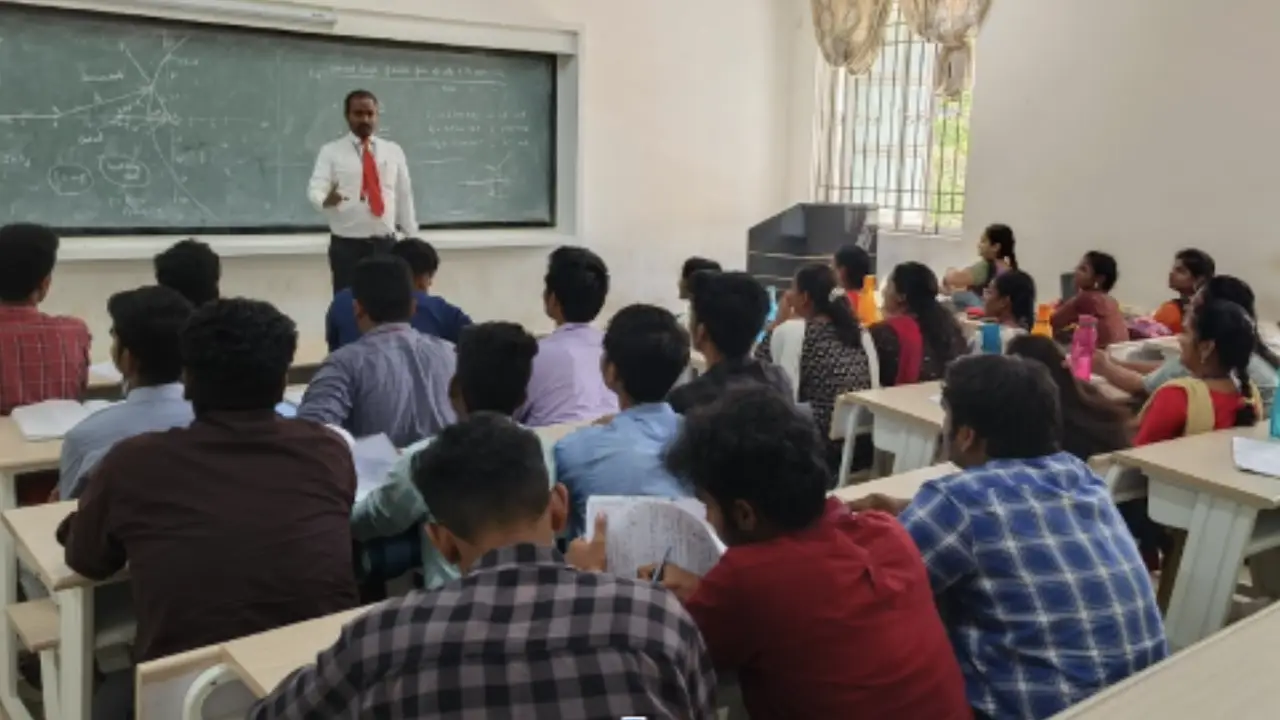
The Department of Electronics and Communication Engineering established in 1999. The department offers a B.Tech programme in Electronics and Communication Engineering with an approved intake of 240, along with M.Tech programmes in Electronics and Communication Engineering and VLSI and Embedded Systems with an intake of 24, and Ph.D. programme supporting advanced research.
The B.Tech programme is accredited by the National Board of Accreditation, and the institution holds NAAC ‘A’ Grade status, reflecting strong adherence to quality standards and outcome-based academic practices. The curriculum is designed to achieve well-defined Program Outcomes and Program Specific Outcomes, integrating industry-relevant electives and emerging technologies.
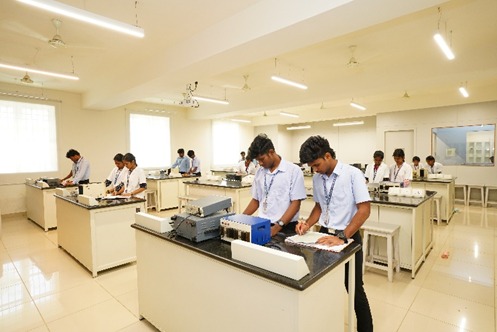
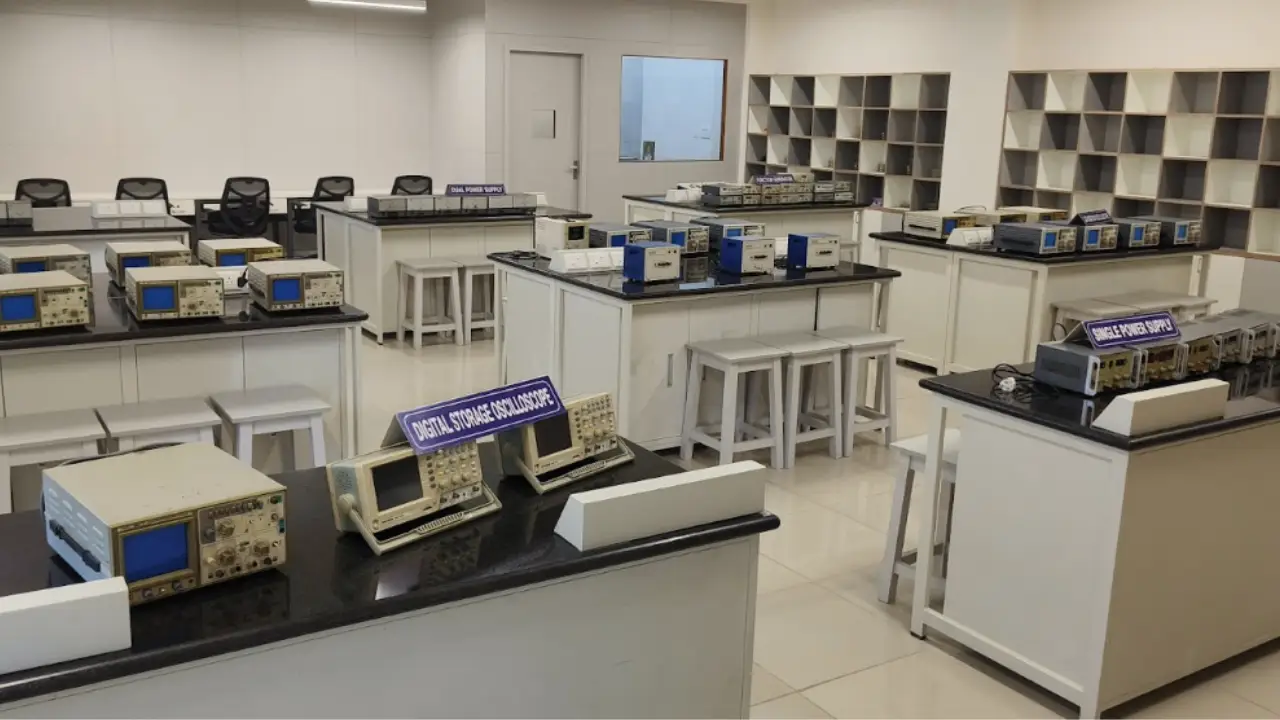
The department is equipped with modern laboratories in Analog Circuits, VLSI Design, IoT, Signal Processing, Wireless Communication, and Embedded Systems, providing hands-on learning using advanced hardware and software tools. Faculty members actively undertake funded research projects supported by agencies such as SERB, MSME, and AICTE. The department regularly organizes guest lectures, workshops, technical seminars, and maintains active MoUs with industries and institutions to strengthen industry interaction and practical exposure. Through continuous quality improvement and a strong research culture, the department strives to nurture competent, innovative, and socially responsible engineers.

Vision
Facilitate academic excellence and research among Electronics and Communication Engineers to meet the global needs with high competence and ethical professionalism.
Mission
M1: Academic Excellence: To impart learning skills to meet the global challenges in the field of Electronics and Communication Engineering
M2: Research and Innovation: To provide excellence in research and innovation through multidisciplinary specialization
M3: Employability and Entrepreneurship: To enhance inter and intra personal skills among students to make them employable and entrepreneurs
M4: Ethics: To inculcate the significance of human values and professional skills to serve the society.
PEO1: Technical Knowledge Graduates will be able to develop an insightful combination of modern electronics and communication technology through technical knowledge.
PEO2: Research and Development : Enhance analytical and thinking skills to develop initiatives and innovative ideas for research and development, industry, and societal requirements.
PEO3: Leadership: Inculcate the qualities of teamwork as well as social, interpersonal and leadership skills and adapt to the changing professional environments in the fields of engineering and technology.
PEO4: Professional Ethics : Motivate graduates to become good human beings and responsible citizens for the overall welfare of the society.
PO1: Engineering Knowledge: Apply knowledge of mathematics, natural science, computing, engineering fundamentals and an engineering specialization to develop to the solution of complex engineering problems.
PO2: Problem Analysis: Identify, formulate, review research literature and analyze complex engineering problems reaching substantiated conclusions with consideration for sustainable development.
PO3: Design/Development of Solutions: Design creative solutions for complex engineering problems and design/develop systems/components/processes to meet identified needs with consideration for the public health and safety, whole-life cost, net zero carbon, culture, society and environment as required.
PO4: Conduct Investigations of Complex Problems: Conduct investigations of complex engineering problems using research-based knowledge including design of experiments, modelling, analysis & interpretation of data to provide valid conclusions.
PO5: Engineering Tool Usage: Create, select and apply appropriate techniques, resources and modern engineering & IT tools, including prediction and modelling recognizing their limitations to solve complex engineering problems.
PO6: The Engineer and The World: Analyze and evaluate societal and environmental aspects while solving complex engineering problems for its impact on sustainability with reference to economy, health, safety, legal framework, culture and environment.
PO7: Ethics: Apply ethical principles and commit to professional ethics, human values, diversity and inclusion; adhere to national & international laws.
PO8: Individual and Collaborative Team work: Function effectively as an individual, and as a member or leader in diverse/multi-disciplinary teams.
PO9: Communication: Communicate effectively and inclusively within the engineering community and society at large, such as being able to comprehend and write effective reports and design documentation, make effective presentations considering cultural, language, and learning differences
PO10: Project Management and Finance: Apply knowledge and understanding of engineering management principles and economic decision-making and apply these to one’s own work, as a member and leader in a team, and to manage projects and in multidisciplinary environments.
PO11: Life-Long Learning: Recognize the need for, and have the preparation and ability for i) independent and life-long learning ii) adaptability to new and emerging technologies and iii) critical thinking in the broadest context of technological change.

PSO1: Domain Knowledge : Ability to understand the concepts in Electronics and Communication Engineering and to apply to different fields, such as Consumer Electronics, Communications, Signal Processing, etc.
PSO2: Embedded System Design : Ability to design a system based on the technical knowledge gained for embedded applications in electronics and communications engineering.
PSO3: Professional Competency : Ability to select cutting-edge engineering hardware and software tools to solve complex problems in Electronics and Communication Engineering
PSO1: Domain Knowledge : Ability to understand the concepts in Electronics and Communication Engineering and to apply to different fields, such as Consumer Electronics, Communications, Signal Processing, etc.
PSO2: Embedded System Design : Ability to design a system based on the technical knowledge gained for embedded applications in electronics and communications engineering.
PSO3: Professional Competency : Ability to select cutting-edge engineering hardware and software tools to solve complex problems in Electronics and Communication Engineering
Welcome to the Department of Electronics and Communication Engineering, where academic excellence and innovation drive our mission. We are committed to delivering quality technical education through an outcome-focused framework that ensures measurable learning and continuous academic improvement. Our curriculum and teaching practices are designed to align with industry needs and emerging technologies. With dedicated faculty, active research initiatives, and strong industry interaction, we promote experiential learning and professional competence. Through systematic review, we strive to nurture skilled, ethical, and globally competent engineers prepared to meet future challenges.
The Department of Electronics and Communication Engineering offers comprehensive academic programmes at undergraduate, postgraduate, and doctoral levels to support academic excellence and research advancement.
Members of Regulation 2020
S. No | Name / Designation / Affiliation | Designation as per UGC |
Minutes of BoS :
Syllabus
Programmes | Regulation 2020 | Regulation 2023 |
B.Tech ECE | ||
M.Tech VLSI and Embedded Systems | ||
M.Tech ECE |
Members of Regulation 2023
S. No | Name / Designation / Affiliation | Designation as per UGC |
Minutes of BoS :
Syllabus:
Programmes | Regulation 2020 | Regulation 2023 |
B.Tech ECE | ||
M.Tech VLSI and Embedded Systems | ||
M.Tech ECE |
Academic Year | No. of Student Placed | No. of Students doing higher studies | No. of Entrepreneur |
2020 – 2021 | 176 | 13 | 2 |
2021 – 2022 | 151 | 15 | 1 |
2022 – 2023 | 144 | 17 | 2 |
2023 – 2024 | 162 | 14 | 1 |
2024 – 2025 | 166 | 17 | 1 |
2025 – 2026 | 103 | 7 | 1 |
Academic Year | Total students | Opted for placements | Student Placed | Percentage of Placement | Total Offers | Average Salary | Highest Salary (LPA) |
2020 – 2021 | 205 | 186 | 176 | 94.62 | 201 | 3.50 | 6.50 |
2021 – 2022 | 172 | 172 | 151 | 87.79 | 180 | 3.95 | 10 |
2022 – 2023 | 210 | 210 | 174 | 82.85 | 180 | 4.34 | 10 |
2023 – 2024 | 216 | 177 | 162 | 91.52 | 182 | 5.38 | 12 |
2024 – 2025 | 218 | 207 | 166 | 80.19 | 202 | 3.31 | 9 |
2025 – 2026 | 242 | 175 | 103 * | 58.85 * | 110 * | 3.56 * | 8.36 * |
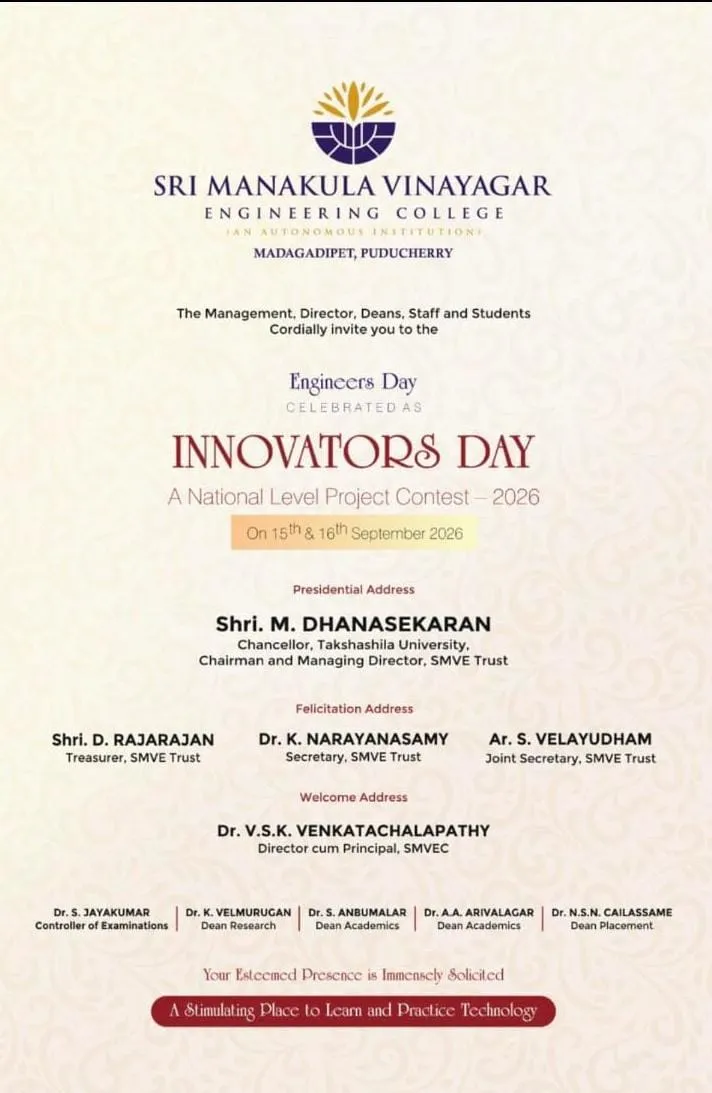
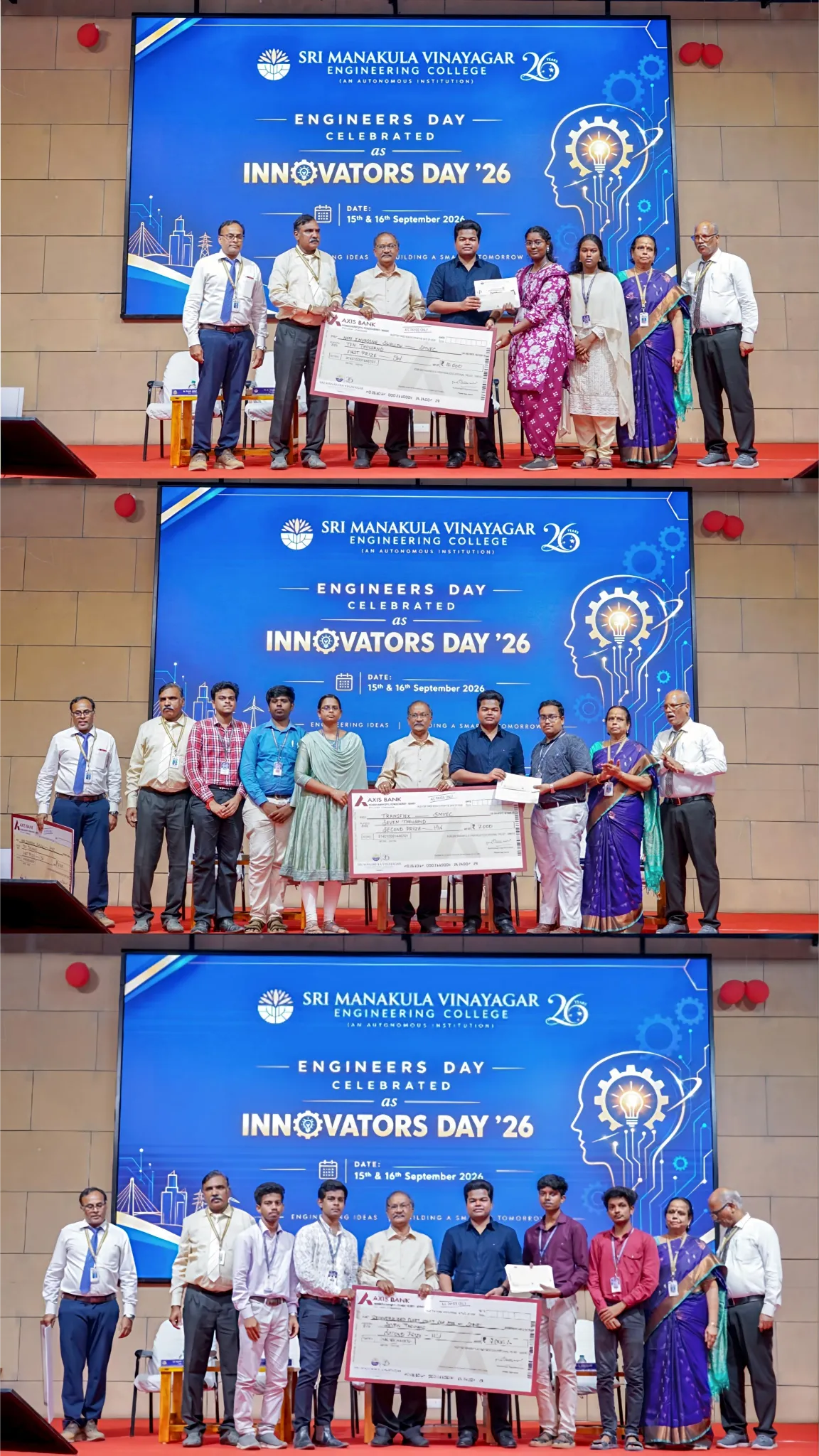
The Department of Electronics and Communication Engineering consistently records notable accomplishments in academics, research, and technical competitions. Students have secured university ranks and won prizes in national-level symposiums, hackathons, project contests, and core domain events. Participation in areas such as VLSI, Embedded Systems, Robotics, IoT, and Communication Engineering reflects strong technical proficiency. Faculty members contribute through quality publications, funded research projects, and professional engagements. These achievements highlight the department’s commitment to academic excellence and innovation.
D:\Website Content for NBA\Student Achievements\Academic Year 2021 – 2022.docx
D:\Website Content for NBA\Student Achievements\Academic Year 2022 – 2023.docx
D:\Website Content for NBA\Student Achievements\Academic Year 2023 – 2024.docx
D:\Website Content for NBA\Student Achievements\Academic Year 2024 – 2025.docx
D:\Website Content for NBA\Student Achievements\2025-2026_ODD Students achievements.docx
Faculty Achievements 🡪 best paper awards, fellowships and recognitions
Publications count
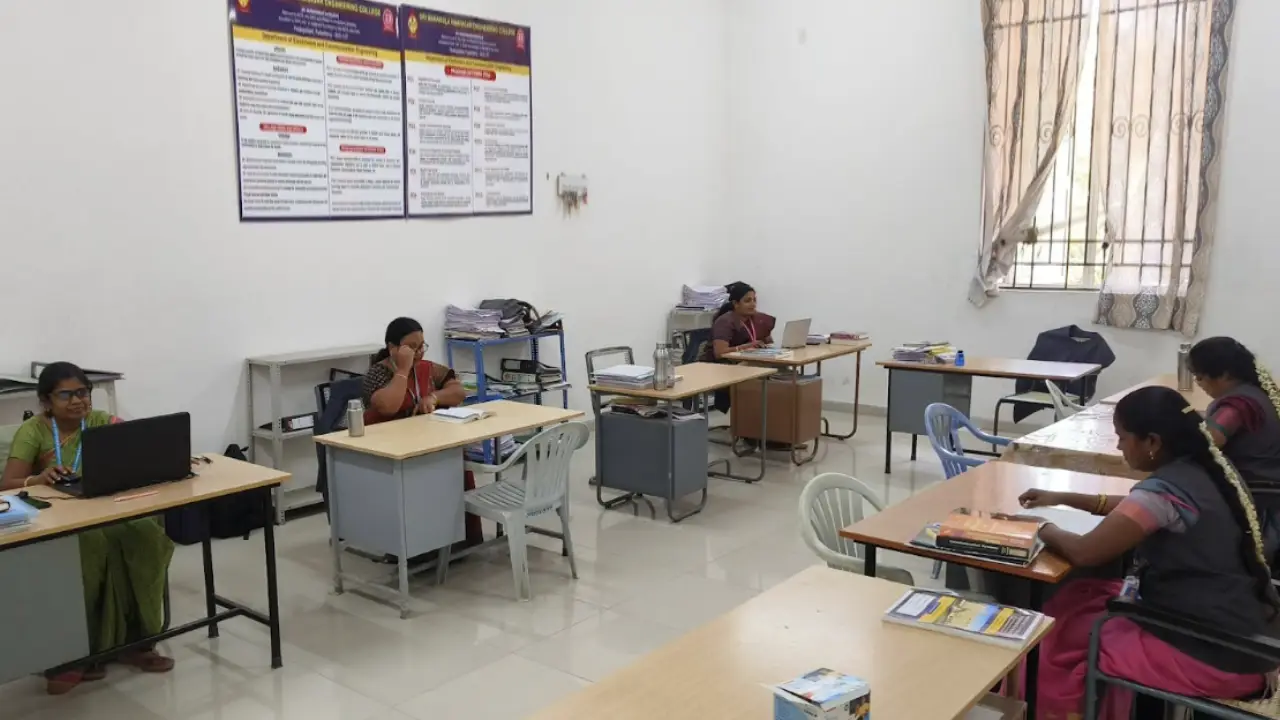
Our Department of Electronics and Communication Engineering has a diversified and highly qualified staff who specialise in VLSI Design, Wireless Communication, Embedded Systems, Image Processing, Antennas, and Microwave Engineering. These professionals provide a dynamic learning environment, conduct cutting-edge research, and work with industries on consulting initiatives. Their competence guarantees that our students get practical, industry-relevant information, and a strong placement related support.
D:\Website Content for NBA\FDP\2021 – 2022\2021 – 2022.docx
D:\Website Content for NBA\FDP\2022 – 2023\2022 – 2023.docx
D:\Website Content for NBA\FDP\2023 – 2024\2023 – 2024.docx
D:\Website Content for NBA\FDP\2024 – 2025\2024-2025.docx
D:\Website Content for NBA\FDP\2025 – 2026\2025 – 2026.docx
Link to Faculty profile pages
Academic Year 2022 – 2023
Academic Year 2023 – 2024
Academic Year 2024 – 2025
Academic Year 2025 – 2026
Link to faculty publication list
Lab Names Updated with area, major equipment, software licenses
D:\Website Content for NBA\Infrastructure\LABORATORY FACILITIES 2025.docx
Class room count, seating capacity, ICT enabled class rooms count
Sl. No | Description | Seating Capacity | Area in Sq. Mts |
Internet Bandwidth available in the department
No. of systems/ workstations in labs
Any centre of excellence/research Lab – Name, funding agency year established
Lab safety measures and practices
Link to lab Manuals (or) equipment inventory list:
The department’s infrastructure creates a dynamic and inventive environment for experiments, research, and hands-on learning in electronics, covering all areas of electronic components, circuits, and systems. Our laboratories include the following:

If you have any inquiries regarding the department, please feel free to reach out to us. We are here to assist you with any questions or information you may need.
Dr. P. Raja, Professor and Head,
Department of Electronics and Communication Engineering
1. Why is SMVEC considered one of the best ECE colleges in Pondicherry and Tamil Nadu?
SMVEC’s ECE Department is NBA-accredited, equipped with advanced laboratories, led by highly qualified faculty, and offers strong placement support in top electronics, communication, and IT companies.
2. What courses does the ECE Department at SMVEC offer?
We offer B.Tech in Electronics and Communication Engineering, M.Tech in Networking, M.Tech in VLSI and Embedded Systems, and Ph.D. programs in cutting-edge ECE domains.
3. How does SMVEC ensure good placements for ECE students?
Our dedicated placement cell provides industry-oriented training, soft skills development, and connects students with leading recruiters in electronics, telecommunications, software, and emerging technology sectors.
4. What infrastructure and facilities are available for ECE students?
The department features modern labs including IoT, VLSI Design, Wireless Communication, Signal Processing, and High-Frequency Communication labs, supporting practical learning and research.
5. Does SMVEC support research and innovation in ECE?
Yes. Our faculty and students work on funded projects from agencies like MSME, SERB, and AICTE, fostering innovation in areas like embedded systems, image processing, and telecommunications.

Hi, I'm SMVEC Chatbot
How can I help you?
SMVEC 25 Years of Legacy | The Official Documentary