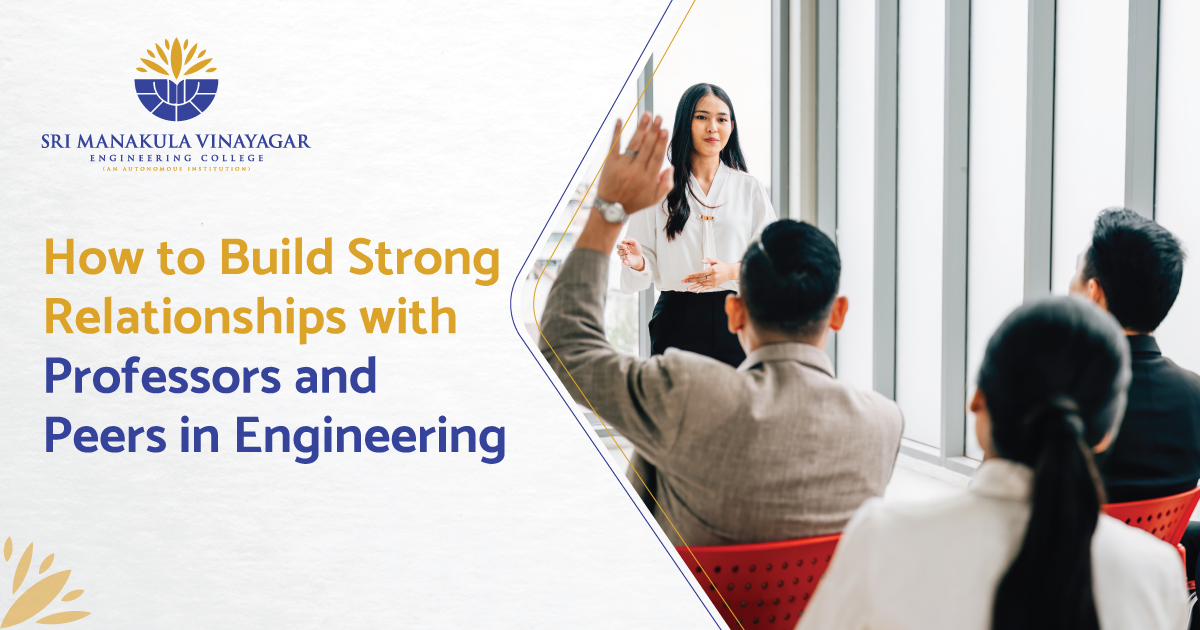
At SMVEC, the education of engineering is not limited to classrooms and exams. Building relationships in the engineering field with professors can help students acquire academic and emotional clarity, valuable career advice, and teamwork skills, all of which are crucial to long-term success.
Introduction
Engineering is sometimes considered an individual process, where one must take exams, complete projects, and undergo technical tests. But even the most powerful factor in college life is that which may not be mentioned much. And at times, the relationships that the students form in the process. Regardless of whether it is the advice of professors or group work with peers, meaningful relationships are important in determining individual performance and progress.
In the case of the engineering students, Building Relationships in Engineering is not all about networking with the aim of networking. SMVEC college involves the establishment of a support system to assist in dealing with the difficulties, enhance learning, and prepare for professional life.
Why Relationships Matter in Engineering Education
Engineering is a teamwork profession. The problems that we face in real-world engineering are rarely handled alone. They require a team, communication, and experience to solve. These skills can be acquired naturally as the strong relationships developed in college assist the student.
Positive academic relationships provide:
- Enhanced comprehension of the complex concepts.
- Mental and emotional assistance during the stress period.
- Different ideas are exposed.
- Teamwork and trust in communication.
Such advantages go a long way into graduation.
Building Strong Relationships with Professors
1. Understand the Role of Professors Beyond Teaching
Professors are not merely experts in the subject. They are teachers, scholars, business brokers, and counsellors who have travelled the road that students desire to follow. A good rapport with the faculty personnel can also create access to academic clearance, research prospects, as well as professional advice.
2. Active and Participative in the Classroom
An active engagement is among the easiest ways to connect with professors. Asking relevant questions, providing inputs to discussions and showing interest in the matter provides a good impression.
This does not imply talking all the time, but rather the engagement, which is worthwhile.
3. Approach Professors with Purpose
They should be able to meet faculty before examinations instead of approaching them to:
- Clarify concepts
- Seek project guidance
- Discuss career paths
- Ask them for academic advice
Professors admire students who take initiative and have an interest to learn.
4. Respect Time and Boundaries
Trust is created through professionalism. Being on schedule, prepared and respectful during an interaction is a way of strengthening relationships. Such basic routines as writing e-mails properly, keeping office hours with responsibility, acting according to the rules of schooling, etc, do a lot.
5. Stay Consistent, Not Transactional
Good relations are built as time goes on. Students who socialise at all times and not just when they require something to develop deeper connections founded on trust and respect.
Building Strong Relationships with Peers
1. Embrace Teamwork Early
Engineering life deals with group projects, technical events, and lab work. Being an active team member makes students aware of various styles of working, strengths, and views.
Teamwork develops communication skills and teaches conflict resolution, which are vital to future engineers.
2. Be willing to listen to other points of view
Engineering classes combine students with different backgrounds, areas and ways of thinking. The acceptance of differences and an open mind will lead to healthier peer relationships and enhance collaboration.
3. Support, Do Not Compete Too Hard
Competition is healthy and can motivate growth, but overcomparison is destructive to relations. Knowledge sharing, assisting classmates, and congratulating one another during the success in learning successes create a good learning atmosphere.
Achieving success in engineering is not often an individual achievement.
4. Be involved in Campus Activities
The best places to form connections are clubs, technical societies, cultural events, sports and student chapters. These platforms assist students in connecting beyond the school stress and establishing strong friendships.
5. Communicate Clearly and Honestly
Effective communication eliminates miscommunication, particularly in group work. Being respectful and listening is important to enhance peer confidence and collaborative effort.
How Relationship-Building Shapes Future Careers
Engineering professions are work-intensive. Engineers collaborate, interact with customers and cross-departmental coordination. Students who learn relationship-building at college acclimate better to professional settings.
Benefits include:
- Strong teamwork skills
- Greater leadership skills.
- Professional confidence
- A reliable support network
These are the skills that are usually of more significance than technical knowledge in the long run.
How SMVEC Encourages Strong Academic Relationships
At the SMVEC college, relationship-building is a part of the learning ecosystem. The college supports a social setting that allows the students to communicate with one another, partner and develop both academically and personally.
The student-focused nature of SMVEC has been shown to keep the members of the faculty friendly and helpful. Through well-organised mentoring, interactive classroom sessions, and practical learning experiences, students are mentored to be active learners as opposed to passive learners.
The SMVEC has a campus culture that facilitates teamwork by:
- Professional societies and technical clubs.
- Sports activities and culture.
- Events and symposiums organised by students.
- Teamwork and learning by doing.
These platforms assist students in socialising with other students in different departments as they build on communication and leadership abilities. Faculty mentorship also assists the students in planning their academics, career choices and growth.
Providing an environment in which students and professors work in close contact, SMVEC naturally assists in Building Relationships in Engineering, as it enables students to be ready not only to succeed in their studies but also to enter professional life.
Common Mistakes Students Should Avoid
During the process of establishing relationships, the students must be aware of:
- Approaching professors just because he or she want marks or favours.
- Violation of the duty of teamwork.
- Lack of communication when working in a group.
- Not to interact because of fear or hesitation.
We gain confidence through practice. Doing little bits will always result in good relationships.
Practical Tips to Start Today
- Getting along with new friends at times.
- Ask questions when the lectures are over.
- Participate in at least one activity or a club.
- Assist with group work.
- Be courteous and approachable.
Such mere measures can turn college experiences into a different dimension.
Conclusion
It is not only about studying a subject that matters to engineering education, but how to get along with people. A good bonding with the professors and the peers will provide a great support system, which will boost learning, confidence and career preparedness.
Consciously, through Building Relationships in Engineering, the students get ready themselves with not just the ability to excel in their studies but also to excel in their careers in working in groups where they have to interact with others in the real world.
FAQs
1. What is the significance of relationships to engineering students?
They offer educational assistance, emotional stability, group collaboration and career advice, which are vital in long-term success.
2. What can students do to improve their relations with professors?
Remaining active in the classroom, expressing courtesy, engaging in advice outside the exams, and being consistent.
3. Is there any impact of peer relationships on academic performance?
Yes. Constructive interactions among peers lead to better cooperation, less stress, and better results.
4. Do introverted students develop good academic relations?
Absolutely. The interactions that one experiences with others, small yet meaningful, with time, tend to be more effective than regular socialising.
5. How does relationship-building help after graduation?
It strengthens communication, teamwork, and leadership skills, qualities highly valued in engineering careers.