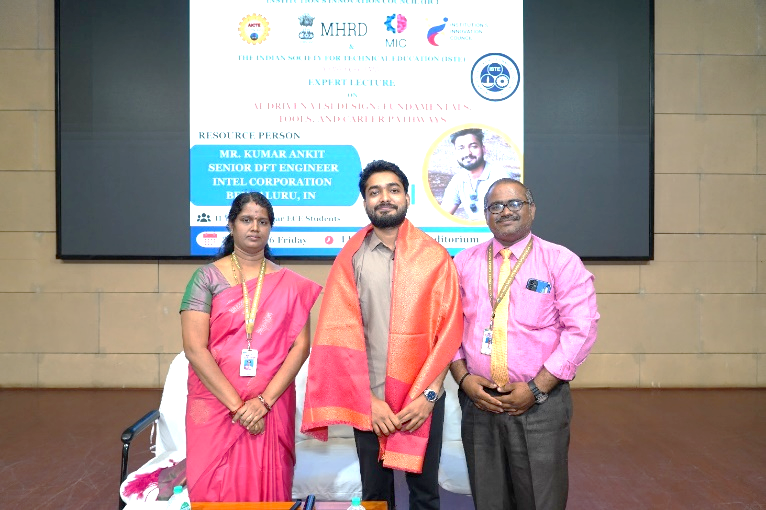
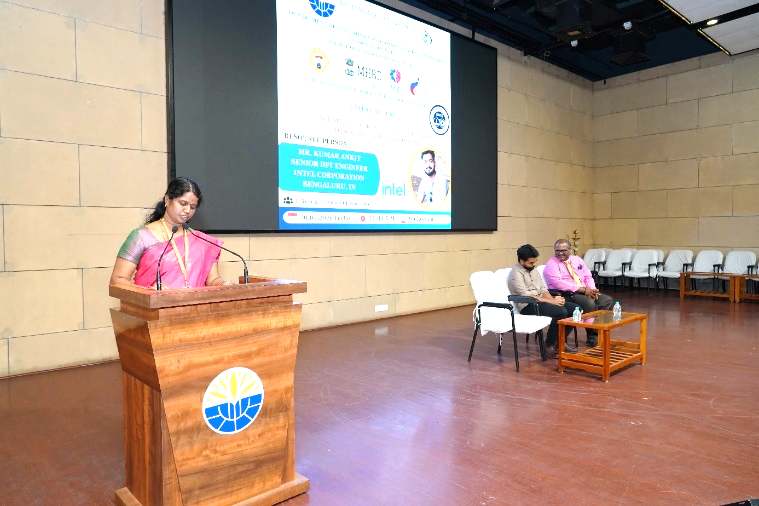
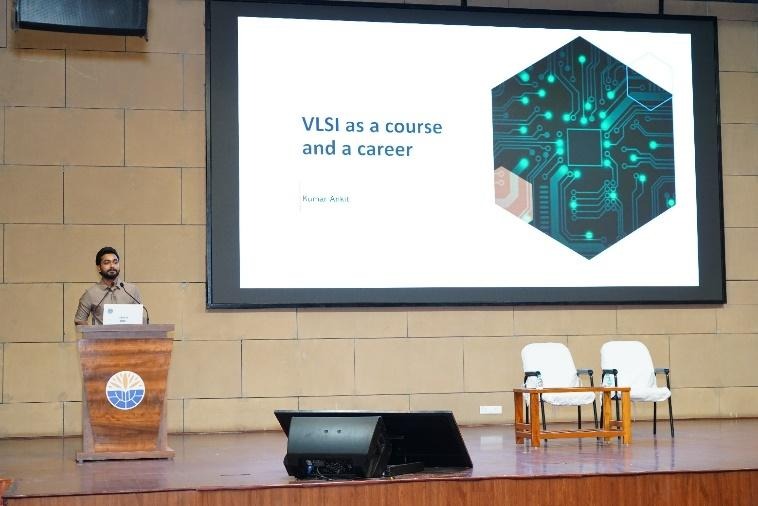
Expert Lecture on “AI-Driven VLSI Design: Fundamentals, Tools, and Career Pathways”
Date : 30th January 2026
Themes and Topics Covered:
- Overview of VLSI and Its Significance
- Evolution of IC technology from SSI to VLSI
- Importance of VLSI in modern electronic systems
- Applications in AI hardware, communication, automotive, and consumer electronics.
The session began with an introduction to Very Large-Scale Integration (VLSI), explaining its evolution and significance in today’s electronics-driven world. The speaker emphasized how VLSI technology enables high-performance, low-power, and compact systems that form the backbone of modern digital applications.
- Moore’s Law and Semiconductor Innovation
- Concept and historical relevance of Moore’s Law
- Impact of transistor scaling on performance and power
- Challenges and future directions in semiconductor scaling
The expert explained Moore’s Law and its role in driving continuous innovation in the semiconductor industry. The discussion covered both the benefits of scaling and emerging challenges, highlighting how advanced technologies and AI-assisted approaches sustain innovation.
- Complete VLSI Design Flow
- Design specification and architectural planning
- RTL design, verification, and synthesis
- Physical design, fabrication, and testing
A detailed overview of the end-to-end VLSI design flow was presented, enabling students to understand how an integrated circuit progresses from concept to silicon and linking academic concepts with industry practices.
- Role of AI in VLSI Design and DFT
- AI-based design optimization
- Machine learning in verification and fault detection
- AI-assisted Design for Testability (DFT)
The growing role of Artificial Intelligence in optimizing VLSI workflows was highlighted, demonstrating how AI improves efficiency, reduces development time, and enhances reliability.
- Job Profiles in the VLSI Industry
- RTL Design Engineer
- Verification Engineer
- DFT Engineer
- Physical Design Engineer
Various career roles in the semiconductor industry were explained along with their responsibilities and skill requirements, helping students identify suitable career paths.
- Essential Skills for a VLSI Career
- Technical skills: Digital electronics, HDL, VLSI tools
- Soft skills: Communication, teamwork, problem-solving
- The importance of combining strong technical foundations with essential soft skills was emphasized for long-term industry success.
- Career Roadmap for Students
- Academic preparation and skill enhancement
- Projects, internships, and certifications
- Long-term career planning
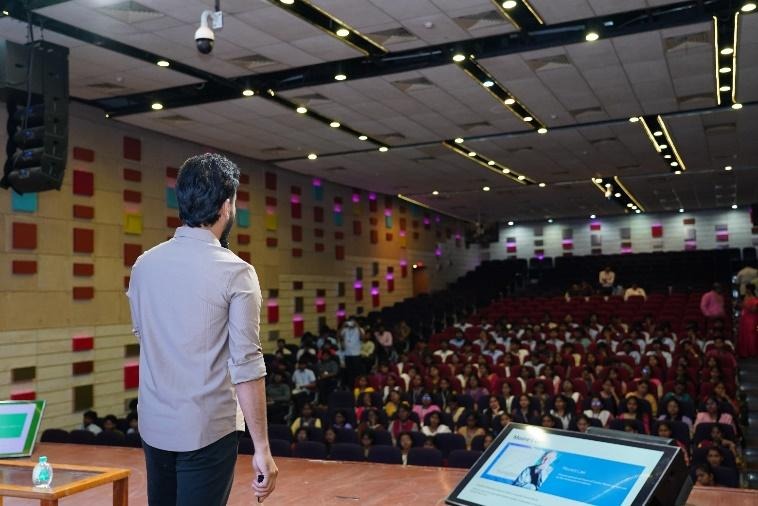
The session concluded with a practical roadmap guiding students on how to prepare for and build a successful career in the VLSI and semiconductor domain.
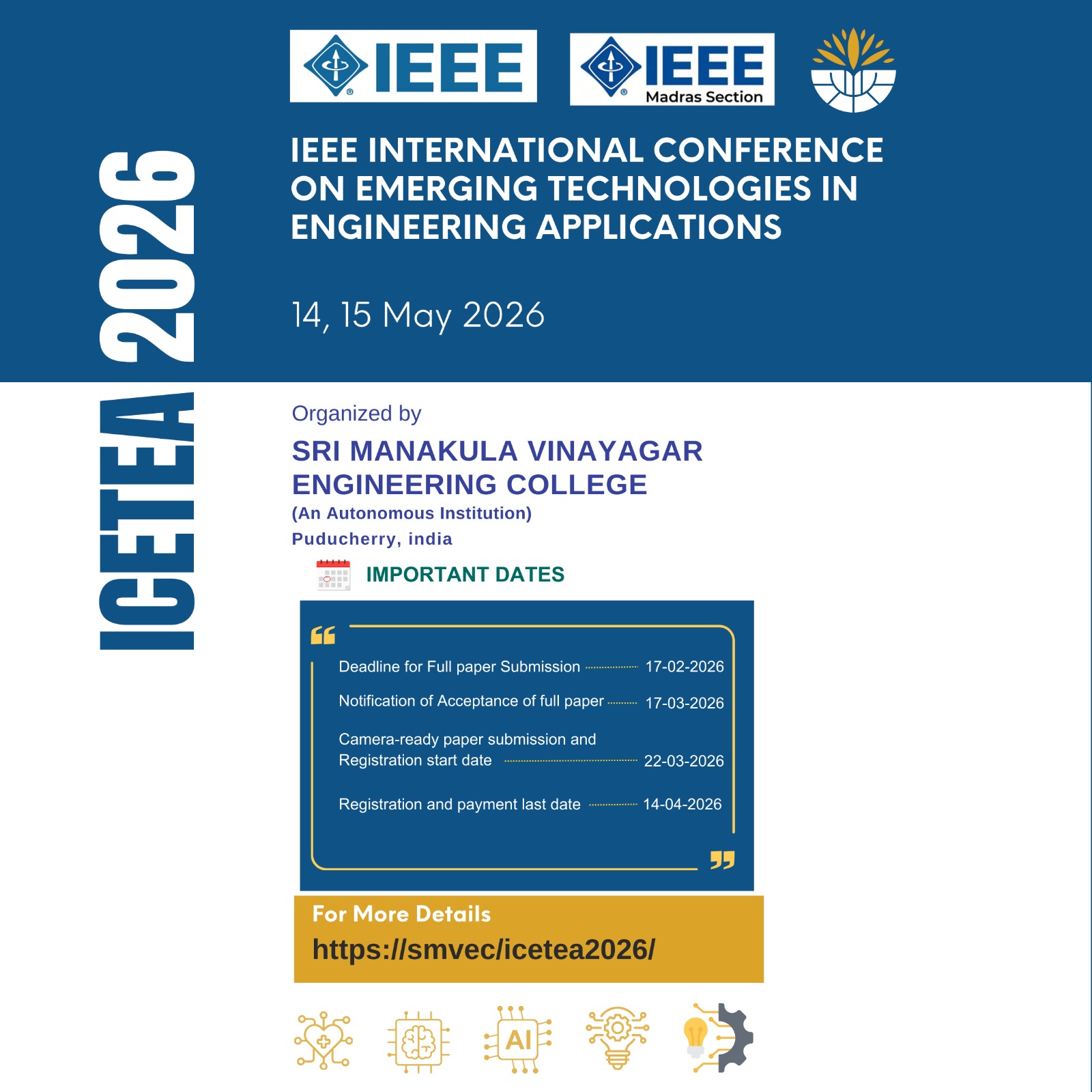
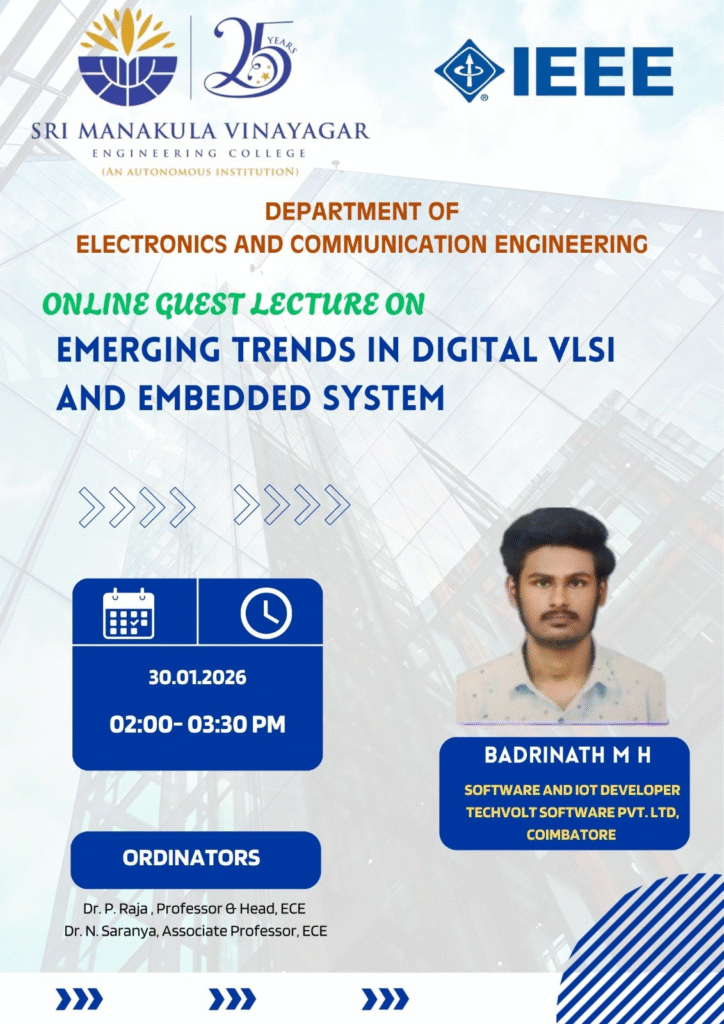
The Department of Electronics and Communication Engineering, Sri Manakula Vinayagar Engineering College, is organizing an Expert and Guest Lecture Series focusing on Emerging Trends in Digital VLSI and Embedded Systems and AI-Driven VLSI Design. The sessions will cover fundamentals, current industry tools, practical applications, and career pathways, delivered by experienced industry professionals. This initiative aims to provide II and III year ECE students with industry exposure and awareness of evolving technologies in VLSI and embedded systems.